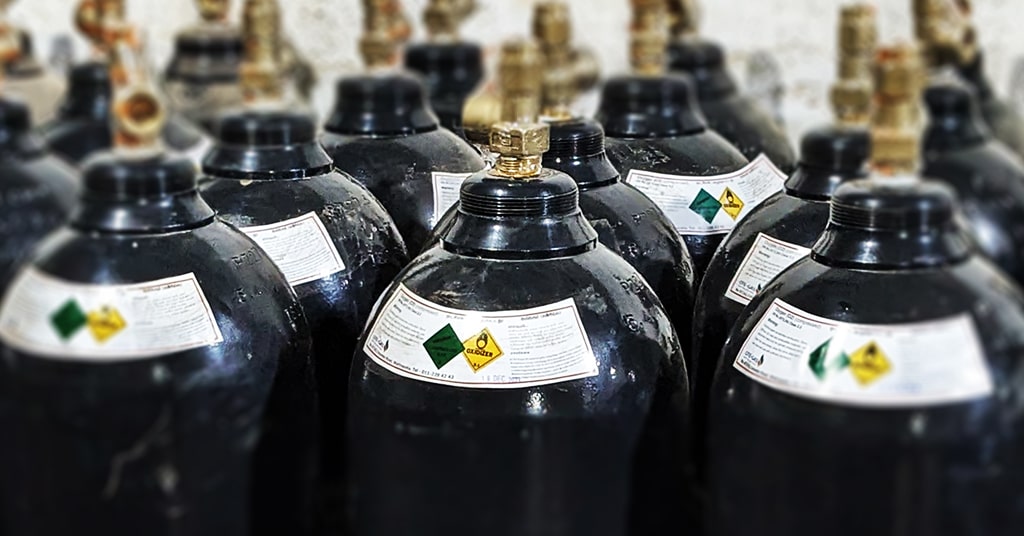
Industrial Oxygen
A reactive gas, oxygen is colourless, odourless, and tasteless.
At -183.0°C (-297.4°F), it becomes a pale blue liquid, while at -218.4°C, it becomes a
solid. Life on Earth depends on oxygen, which accounts for 21% of the atmosphere. Air
separation plants
mainly obtain oxygen by fractional distilling liquid air. Oxygen has a wide range of
applications.

Uses
The primary application of
oxygen in medicine is oxygen therapy. Patients with breathing difficulties are given
pure or nearly-pure oxygen during surgery, childbirth, heart attack recovery and
infectious disease treatment. As a result, patients recover
faster and their hearts and lungs are less stressed. A pure oxygen source can also
be used in situations in which breathing is difficult. This is, for example, when
high-altitude mountain climbing is required or when the regular air supply
is compromised in an aircraft.
The most extensive industrial use of oxygen in Sri Lanka is metallurgy. Oxyfuel
torches cut and weld metals with hydrogen or acetylene gas as fuel. With flame
temperatures that exceed 3,000°C (-5,400°F), these torches can cut and weld most
metals.
In
addition to processing iron ore and steel, oxygen is also used in industries that
utilize kilns. In liquid form, or LOX, oxygen fuels rockets. For a rocket to reach
space, oxygen is crucial. Oxygen is also essential for chemical synthesis.
Oxygen is used in water purification and wastewater treatment plants to crack
hydrocarbons to make ethylene and propylene. Oxygen can also be used to incinerate
waste in closed systems.
- Mini and Large gas cylinders